

Imagine driving a car with the alignment badly off. You can replace the tire. Rotate the tire. Balance the tire. But until you correct the alignment, the tire will continue to wear out. Your spinal discs often work the same way.
When the lumbar spine loses its normal curve, abnormal forces can become concentrated on specific discs day after day, year after year. Eventually, those discs begin to fail under the stress.
- The result may be:
- Disc bulges
- Disc herniations
- Disc degeneration
- Nerve Irritation
- Chronic low back pain
- Sciatica
So the question to ask yourself is not only: “How do we calm the disc down?”
But also: “Why is the disc under excessive stress in the first place?”
That’s where a chiropractor enters the picture. Many chiropractors focus solely on reducing symptoms. Cummins Chiropractic is different! Here, we focus on why the disc became injured in the first place, and figure out how to solve the root of the pain.
A Herniated Disc Is Often Like a Jelly Donut
Think about squeezing a jelly donut.
If pressure is evenly distributed, the filling stays where it belongs. If pressure repeatedly pushes from one side, the filling begins to move outward.
A spinal disc behaves similarly. Over time, abnormal posture and spinal alignment can lead to uneven loading of the disc. This may contribute to disc bulges, herniations, and ongoing irritation of nearby nerves.
Signs Your Herniated Disc Is Not Healing
If your pain keeps returning after chiropractic treatment, it’s one of the clearest signs your herniated disc is not healing at the root cause level. Temporary relief without structural correction means the disc is continuing to absorb the same abnormal forces that injured it in the first place.
At Cummins Chiropractic & Wellness, we focus on identifying and correcting those structural stresses through Chiropractic BioPhysics® (CBP®), a research-based approach that restores more normal spinal alignment and posture through:
- Specific chiropractic adjustments
- Mirror-Image® exercises
- Postural rehabilitation
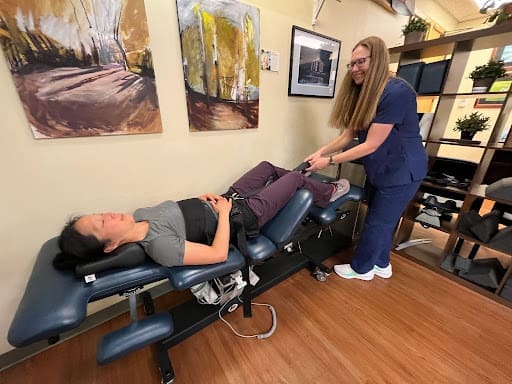
- Spinal traction designed to restore spinal curves
Rather than simply chasing symptoms, CBP seeks to improve the mechanical environment surrounding the injured disc. The goal is to reduce abnormal loading and support long-term healing.
One of the most fascinating studies involving disc herniation and CBP followed a patient with a severe lumbar disc herniation and disc sequestration. The patient had already undergone treatment with three different chiropractors and continued to experience significant symptoms.
Researchers then implemented a CBP lumbar extension traction program designed to restore the normal lumbar curve.
The results were remarkable. After six weeks:
- Symptoms were dramatically reduced
- Function improved
- MRI findings showed substantial healing
Perhaps even more impressive, researchers followed the patient for eight years and found the improvements remained stable. The authors concluded that restoring lumbar lordosis through lumbar extension traction appeared to facilitate healing of the disc injury while providing long-term symptom relief.
Reference: Oakley PA, Harrison DE. Lumbar extension traction alleviates symptoms and facilitates healing of disc herniation/sequestration in 6-weeks, following failed treatment from three previous chiropractors: a CBP® case report with an 8 year follow-up. Journal of Physical Therapy Science. 2017;29(11):2051-2057.
Cummins’ Herniated Disc Chiropractic Treatment
Spinal Decompression
Many patients inquire about spinal decompression as part of their chiropractic care for a herniated disc. Think of it as creating a gentle unloading force within the spine, reducing pressure on injured discs and irritated nerves to create a more favorable environment for healing.
Many patients report the following after spinal decompression treatment:
- Reduced leg pain
- Improved mobility
- Less pressure in the lower back
- Greater comfort sitting and standing
For some patients, spinal decompression serves as an excellent complement to corrective chiropractic care.
Erchonia Laser Therapy
Healing requires more than simply reducing pressure; the injured tissues must also repair themselves.
Erchonia low-level laser therapy is designed to support cellular healing and tissue recovery. Research suggests it helps:
- Reduce inflammation
- Improve circulation
- Support tissue repair
- Reduce pain
When combined with spinal correction and decompression, laser therapy may help accelerate the healing process for some patients.
The Bigger Goal: Better Nervous System Function
While many treatments focus solely on pain, Cummins chiropractic care for herniated discs focuses on the relationship between the spine and the nervous system.
Your nervous system controls every organ, tissue, muscle, and cell in your body. When spinal dysfunction interferes with normal movement and nerve communication, the body’s ability to function and heal is compromised.
By improving spinal alignment and reducing abnormal mechanical stress, we aim to help your nervous system function more efficiently and support your body’s healing.
Frequently Asked Questions About Disc Herniation
Can a Chiropractor Help a Herniated Disc?
Of course! Chiropractic care can address the structural issues that keep a herniated disc under stress, not just the pain itself. Through herniated disc chiropractic treatment techniques like spinal adjustments, traction, and decompression, many patients experience significant and lasting improvement without surgery.
Can a Disc Herniation Heal Without Surgery?
Many disc herniations can improve without surgery. The body’s natural healing processes can often reduce inflammation, resorb portions of herniated disc material, and improve symptoms over time. The key is creating a mechanical environment that supports healing, which is exactly what corrective chiropractic care is designed to do.
How Long Does Chiropractic Care for a Herniated Disc Take?
Every case is different. Some patients experience significant improvement within weeks. Others may require several months, depending on:
- The severity of the injury
- The duration of symptoms
- Overall health and activity level
- Structural alignment of the spine
- Consistency with treatment recommendations
The longer an underlying structural problem has existed, the more time may be needed to create lasting change.
When Should Surgery Be Considered?
Surgery may be appropriate in certain situations, including:
- Progressive neurological weakness
- Loss of bowel or bladder control
- Severe neurological compromise
- Symptoms that fail to respond to appropriate conservative care
For many patients, however, chiropractic treatment for a herniated disc should be explored thoroughly before considering invasive procedures.
Now Is the Time to Address the Root Cause
If your disc could talk, it probably wouldn’t ask for another pain pill. It might ask for:
- Less pressure
- Better alignment
- Greater movement
- More support
- Improved nervous system function
At Cummins Chiropractic & Wellness, we combine Chiropractic BioPhysics® (CBP®), spinal decompression, Erchonia laser therapy, rehabilitation, and herniated disc chiropractic treatment to address the underlying causes of disc-related conditions, not just the symptoms.
If you’ve been chasing a life without pain for months or even years, it may be time to try something new. Book an appointment with Cummins Chiropractic today.