


You’ve decided to see a chiropractor, but then you discover that chiropractors don’t all practice the same way.
Some primarily adjust the spine. Others focus on sports injuries, soft tissue, rehabilitation, upper cervical care, or wellness. And some chiropractors use Chiropractic BioPhysics®, or CBP®, to evaluate and rehabilitate posture and spinal alignment.
So, what’s actually different? And if you’re looking for a chiropractor in Bellevue, how do you know which approach is right for you?
The answer starts with understanding that not all chiropractic care is trying to accomplish exactly the same thing.
The key difference is that traditional chiropractic care commonly focuses on improving spinal joint motion and function through adjustments, while Chiropractic BioPhysics (CBP) builds on those adjustments by incorporating detailed posture and spinal alignment assessments, individualized corrective exercises, and spinal traction designed to improve measurable spinal alignment and curvature. CBP places additional emphasis on correcting spinal structure as part of a comprehensive approach to spinal health and function.
What Does a Regular Chiropractor Do?
Chiropractic is a broad profession with many different techniques and approaches. The good news is that chiropractors share a common focus on the spine, which plays a vital role in protecting the spinal cord and supporting communication between the brain and body!
Chiropractic adjustments are commonly used to improve joint motion, support spinal function, and address musculoskeletal concerns. There are many excellent chiropractors practicing a wide variety of techniques, each bringing their own unique approach to patient care.
In fact, there is no single type of “regular” chiropractor. Some chiropractors focus on specific regions of the spine, such as the upper cervical area, while others specialize in caring for children, athletes, or pregnant women.
For example, Chiropractic BioPhysics (CBP), Diversified, Gonstead, Activator Methods, Thompson Drop Table, Flexion-Distraction, Webster, NUCCA, and Blair are all examples of chiropractic techniques that use different methods to evaluate and care for the spine.
Each of these techniques offers a unique approach to chiropractic care, with the shared goal of helping patients improve spinal health, movement, and overall function.
Chiropractic BioPhysics (CBP) builds upon traditional chiropractic care by taking a more comprehensive approach to spinal structure and posture. CBP can be integrated with many chiropractic techniques, adding specialized assessments, corrective exercises, and spinal traction to help improve the overall alignment and structure of the spine.
How to Decide Between Regular Chiropractic and a Specialty Chiropractor
The connection between the brain and body is essential to overall health, and chiropractic care focuses on supporting spinal health and function. Once you’ve decided to see a chiropractor, the next question becomes, “How do I find the best chiropractor for me?”
Depending on the chiropractor’s approach and the patient’s individual needs, care may also incorporate additional therapies such as exercise, laser therapy, spinal decompression, massage, soft-tissue techniques, rehabilitation, and lifestyle recommendations.
When a problem becomes chronic, repeatedly returns, or is associated with significant postural changes, there’s another important question to consider: Could the overall structure and alignment of the spine be contributing to the problem?
This is where Chiropractic BioPhysics (CBP) adds another dimension to chiropractic care. While many traditional chiropractic techniques focus on identifying and adjusting specific joints or regions of the spine to improve movement and function, CBP emphasizes a broader structural approach. It evaluates overall spinal alignment, posture, and how different regions of the spine work together.
CBP can be incorporated alongside many chiropractic adjusting techniques, adding specialized corrective exercises and spinal traction designed to improve measurable spinal alignment over time.
What Is Chiropractic BioPhysics (CBP)?
Chiropractic BioPhysics®, commonly called CBP®, is a specialized chiropractic technique that places particular emphasis on posture, spinal alignment, and structural rehabilitation.
CBP is an additional technique that chiropractors can incorporate into their practice alongside traditional chiropractic care.
Traditional chiropractic care often focuses on individual areas of the spine, using adjustments to improve joint movement and function while supporting the relationship between the spine and nervous system. CBP expands on this approach by looking at the spine as a whole, including its natural curves, overall alignment, and posture. CBP uses research-based spinal alignment models to evaluate these natural curves and identify measurable structural deviations that may contribute to pain or reduced function.
In other words, CBP allows chiropractors to evaluate the spine on two levels:
- Segmental level: How are individual vertebrae moving and functioning?
- Global level: How is the entire spine aligned, and could abnormal posture or spinal structure be contributing to the patient’s problems?
Rather than asking only, “How can we improve spinal function and support communication between the brain and body?” CBP also asks:
“What does this person’s posture and spinal alignment actually look like — and could abnormal spinal structure be contributing to the pain, dysfunction, or other problems we’re trying to address?”
Depending on the patient’s history and clinical findings, a CBP evaluation may include:
- Postural analysis
- Objective spinal measurements
- Functional examination
- X-rays when clinically appropriate
- Analysis of spinal alignment and curvature
- Periodic reassessment to measure progress
When structural rehabilitation is appropriate, CBP may incorporate three important components known as Mirror Image® methods:
- Mirror Image® adjustments
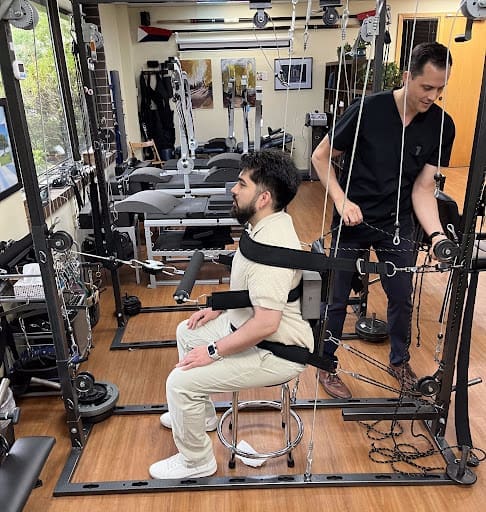
- Mirror Image® corrective exercises
- Mirror Image® traction
The concept behind Mirror Image® is to identify the direction of a postural deviation and apply specific corrective positions and forces in the opposite direction. These methods are designed to help restore more normal spinal alignment and posture over time.
The idea is not simply to identify where someone hurts. It is to determine whether there is a measurable structural problem and, when appropriate, apply individualized specific corrective forces over time and reassess the results.
By incorporating CBP into their practice, chiropractors gain additional tools to address both how individual spinal segments move and function and the overall structure and alignment of the spine, with the goal of creating lasting improvements in posture and spinal function.
Why Look at Posture in the First Place?
Life places a lot of stress on the body. We work, sit, drive, look at phones and computers, raise families, exercise, play sports, and accumulate years of repetitive stress, often without ever thinking much about taking care of our spine and posture.
That’s why some patients are surprised when we evaluate their global posture and discover that their head, shoulders, spine, and pelvis aren’t aligned the way they expected. Patterns like forward head posture are common and often go unnoticed for years.
We can see postural challenges in younger people, too. Children and teenagers are spending significant time with technology, while young athletes may place substantial repetitive demands on their developing bodies through competitive and elite sports.
That doesn’t mean every adult or child with a postural change needs corrective care. But when a meaningful posture problem is present, identifying it gives us the opportunity to ask whether improving structure could provide a healthier foundation for movement and function.
Chiropractic Adjustment and Structural Rehabilitation: What’s the Difference?
One of the most important distinctions when comparing traditional chiropractic care and Chiropractic BioPhysics (CBP) is understanding the difference between a chiropractic adjustment and a structural rehabilitation program.
An adjustment and a structural rehabilitation program aren’t necessarily trying to accomplish exactly the same thing. In fact, specialized Mirror Image® adjustments are one component of the CBP protocol. A chiropractic adjustment is commonly used to improve joint motion and function. Structural rehabilitation has an additional goal: creating measurable changes in posture or spinal alignment when those changes are clinically appropriate.
Think about other forms of rehabilitation. If you want to strengthen a muscle, you don’t expect one exercise session to produce lasting changes. If you’re rehabilitating an injury, you don’t perform an exercise once and assume rehabilitation is complete. The body generally requires an appropriate stimulus repeated over time to produce adaptation.
Structural rehabilitation applies a similar concept to posture and spinal alignment. When an examination identifies a significant structural issue, the chiropractor may recommend repeated corrective positioning, exercises, and traction in addition to adjustments.
That’s an important distinction: An adjustment is part of the treatment. Specifically, a mirror image adjustment. Structural rehabilitation is a process.
Why Is Spinal Traction Used in CBP?
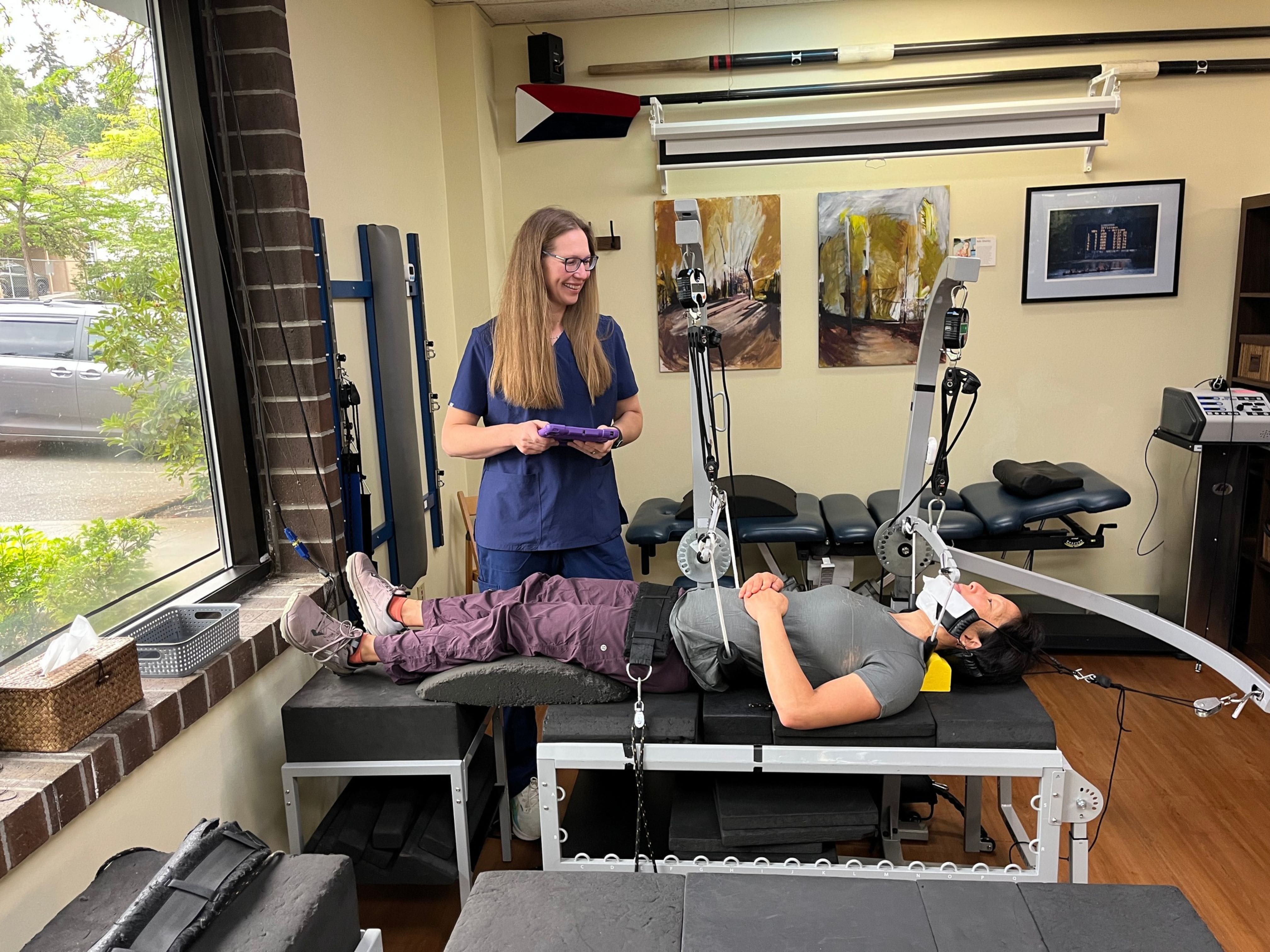
Postural traction is one of the tools that differentiates CBP structural rehabilitation from chiropractic care centered primarily around adjustments.
Traction applies a controlled corrective force to the spine over a longer duration than an adjustment. The direction, position, duration, and progression of that traction are selected according to the patient’s individual structural findings, with the goal of gradually improving spinal alignment and restoring more normal spinal curves.
Research has demonstrated that specific spinal traction protocols used in Chiropractic BioPhysics can produce measurable improvements in spinal alignment. A 2020 systematic review of controlled clinical trials found improvements of approximately 7–11 degrees in lumbar spinal curvature after 30–36 treatments over 10–12 weeks. In the randomized trials, improvements in spinal alignment, pain, and disability were largely maintained at six-month follow-up, while comparison groups did not demonstrate comparable structural improvements. [1]
Research has also examined cervical spine correction and its relationship to headaches and nervous system function. A 2021 randomized controlled trial found that patients receiving cervical extension traction experienced greater improvements in cervical alignment and better long-term headache outcomes compared with patients receiving rehabilitation without traction. Another 2021 randomized controlled trial identified measurable changes in certain nervous system functions following cervical lordosis rehabilitation. Together, these studies provide additional evidence supporting the role of targeted spinal traction in structural rehabilitation, while highlighting the need for continued research. [2, 3]
The goal isn’t simply to “stretch your back” or “stretch your neck.” CBP traction is designed to apply specific corrective forces to areas of the spine where structural changes have been identified, helping support gradual improvements in posture and spinal alignment over time.
This is why two people who both complain of neck pain may receive very different recommendations. Their symptoms may sound similar, but their posture, spinal alignment, movement patterns, health history, and functional limitations can be very different.
Does Everyone Need CBP or Structural Correction?
The first step is understanding the health and function of your spine. At Cummins Chiropractic & Wellness, we believe everyone can benefit from knowing how their spine and posture are functioning so they can make informed decisions about their health.
Chiropractic care can serve different purposes depending on the individual. Someone seeking occasional relief, improved mobility, or ongoing wellness care may benefit from chiropractic adjustments without needing an extensive structural rehabilitation program.
However, someone with significant postural distortion, altered spinal curvature, chronic mechanical stress, or a problem that repeatedly improves and returns may benefit from a more comprehensive evaluation of spinal structure and alignment.
In our office, some of the patients who benefit most from CBP are people with difficult or recurring problems who have already tried multiple approaches without finding a lasting solution. For some of these patients, evaluating posture and spinal structure reveals another piece of the puzzle that hasn’t previously been addressed. We have seen patients make meaningful improvements in both their posture and how they function when structural rehabilitation is appropriate.
The goal is to identify what each patient’s spine needs to function at its best. When a significant structural problem is contributing to a patient’s condition, addressing it through CBP may be an important part of achieving lasting improvements. The appropriate recommendation should always be based on the individual’s examination findings, health history, and goals.
Does Chiropractic BioPhysics Use X-Rays?
X-rays may be part of a CBP structural evaluation when clinically appropriate.
Looking at someone’s posture from the outside provides useful information, but it doesn’t show everything about the alignment and curvature of the spine itself. When imaging is clinically indicated, X-rays can provide objective measurements that help a chiropractor evaluate spinal alignment and establish a baseline. Many CBP chiropractors have extensive training with full-spine X-ray and looking at the entire body.
This becomes especially relevant when the goal of care includes measurable structural change. If you’re trying to change something, it makes sense to know where you started. Reassessment can then help answer an important question: Did the thing we were trying to change actually change?
At Cummins Chiropractic & Wellness, imaging isn’t about simply finding something “wrong” on an X-ray. It is one part of the overall clinical picture and is used when appropriate to help guide individualized recommendations.
What Makes Cummins Chiropractic & Wellness Different Among CBP Practices?
Dr. Robert Cummins’ approach goes beyond Chiropractic BioPhysics (CBP). His extensive training includes multiple chiropractic adjusting techniques, functional movement assessment, and soft-tissue approaches. By combining these methods with CBP’s emphasis on spinal alignment and structural rehabilitation, he can evaluate both how the spine moves and how it is aligned, helping identify what may be preventing a patient from functioning at their best.
For one patient, the priority may be improving joint motion. Another may need help with soft-tissue restrictions or movement patterns. Others may have significant postural or structural challenges that benefit from corrective rehabilitation. Many patients benefit from a combination of approaches tailored to their individual needs.
This comprehensive, individualized approach helped shape our Foundations of Posture Protocol at Cummins Chiropractic & Wellness. Our protocol brings together chiropractic adjustments, structural rehabilitation, and supportive therapies to address each patient’s needs, with the goal of helping them achieve lasting improvements in spinal health and function.
How Our Foundations of Posture Protocol Works
Our Foundations of Posture Protocol brings different aspects of care together based on the patient’s individual findings and goals.
Regenerate
Help improve joint function and address areas that aren’t functioning optimally. Depending on the individual, this may incorporate chiropractic adjustments, laser therapy, decompression, or other appropriate techniques.
Rehabilitate
When structural findings warrant it, rehabilitation may incorporate corrective exercises and CBP-based postural traction designed around the patient’s individual findings.
Restore
The goal isn’t simply passive treatment. Movement, stability, posture, and appropriate exercise help the patient build better function on that improved foundation.
Ultimately, we want to help give the spine and nervous system a healthier foundation for life. Life continually places stress on the body. When appropriate, restoring better movement, function, posture, and spinal curves can help create an environment that supports energy, healing, and resilience rather than continually reacting to the same mechanical stresses.
Together, these components allow us to look beyond “Where does it hurt?” and ask “Why isn’t this person functioning the way they should — and what can we do about it?”
Choosing a Chiropractic BioPhysics (CBP) Chiropractor in Bellevue
If you’re considering a CBP chiropractor in Bellevue, it’s important to understand the chiropractor’s approach to evaluating and caring for your spine. Ask what they’re evaluating, why X-rays may be recommended, how traction and corrective exercises work, and how progress will be measured. Most importantly, ask how the recommended care relates to your individual findings and health goals.
At Cummins Chiropractic & Wellness, we believe patients should understand four important things: What did we find? What are we recommending? Why are we recommending it? And what are we working to accomplish?
Our goal is to help you understand your spinal health, make informed decisions about your care, and take an active role in building a healthier foundation for life.
Is Chiropractic BioPhysics Right for You?
You don’t need to know whether you need CBP before walking through our doors. That’s what the evaluation is for.
If your posture and spinal structure look good and a corrective program isn’t appropriate, we don’t need to create a structural problem where one doesn’t exist. But if you’ve spent years dealing with recurring symptoms, significant postural changes, altered spinal curves, chronic mechanical stress, or a problem that improves temporarily and keeps coming back, it may be worth asking whether anyone has actually evaluated your structure.
At Cummins Chiropractic & Wellness in Bellevue, our goal isn’t to fit every patient into one technique. It’s to identify the barriers preventing you from functioning at your best and create an individualized plan using the tools that make sense for you.
For some patients, CBP isn’t necessary. For patients with a meaningful posture problem, it can be a game changer. Because getting out of pain can be an important first step — but our bigger goal is to help you build a healthier foundation so you can get better faster and stay better longer.
Gold Medal Health. Amazing Awaits.
CBP Research References